Neurological Manifestations, Treatment Outcomes, and Survival Determinants in Patients with Gliomas Undergoing Postoperative Radiotherapy: A Retrospective Cohort Study from Central Asia
Abstract
Author(s): Nargiza Sunnatillayevna Karimova, Daniyar Anarbayevich Nishanov, Khilola Bakhtiyarovna Abdakhatova, Yashnar Mamasaliyevna Mamadaliyeva, Anvar Pardabayevich Tuychiyev, Khojiakbar Khamid ugli Khamidov and Mukhayo Ravshanovna Khayitboeva*
Background: Malignant gliomas are among the most aggressive primary brain tumors and are associated with poor prognosis despite multimodal treatment. Data regarding neurological complications and prognostic factors in patients with malignant gliomas from Central Asian populations remain limited. This study aimed to evaluate neurological manifestations, treatment-related toxicity, recurrence patterns, and survival-related prognostic factors in patients with malignant gliomas undergoing postoperative radiotherapy. Methods: This retrospective cohort study included 174 consecutive patients with histologically confirmed malignant gliomas treated with surgery followed by radiotherapy between 2018 and 2023. Clinical, radiological, histopathological, and immunohistochemical data were analyzed. Overall survival was estimated using the Kaplan–Meier method, and independent prognostic factors were identified using multivariable Cox proportional hazards regression. Results: Headache (91.4%), general weakness (74.7%), and seizures (47.1%) were the most common neurological manifestations. Three-dimensional conformal radiotherapy was the most frequently used treatment modality (58.0%). Acute post-treatment findings included cerebral edema (83.3%), alopecia (92.5%), and radiation dermatitis (79.9%), whereas persistent headache (87.9%), epilepsy (52.3%), memory impairment (54.0%), and cognitive dysfunction (50.0%) predominated among late follow-up findings. During follow-up, 84 deaths were recorded, and the median overall survival for the entire cohort was 48 months. Kaplan–Meier analysis demonstrated significantly shorter survival in patients with WHO grade IV tumors. Multivariable Cox regression identified higher WHO grade as the only independent predictor of worse overall survival (HR=1.72, 95% CI 1.06–2.78, p=0.028), whereas age, sex, Karnofsky Performance Status, extent of tumor reduction, and radiotherapy technique were not independently associated with survival. Conclusions: Neurological manifestations and long-term outcomes in patients with malignant gliomas were associated with clinical, anatomical, pathological, and treatment-related characteristics. Histological grade represented the principal prognostic factor associated with overall survival in the present cohort, while a substantial burden of acute and delayed neurological findings was documented during follow-up after radiotherapy. Continuous neurological monitoring and multidisciplinary management remain important components of patient care.
Share this article

Editors List
-
RAOUi Yasser
Senior Medical Physicist
-
Ahmed Hussien Alshewered
University of Basrah College of Medicine, Iraq
-
Sudhakar Tummala
Department of Electronics and Communication Engineering SRM University – AP, Andhra Pradesh
-
Alphonse Laya
Supervisor of Biochemistry Lab and PhD. students of Faculty of Science, Department of Chemistry and Department of Chemis
- Fava Maria Giovanna
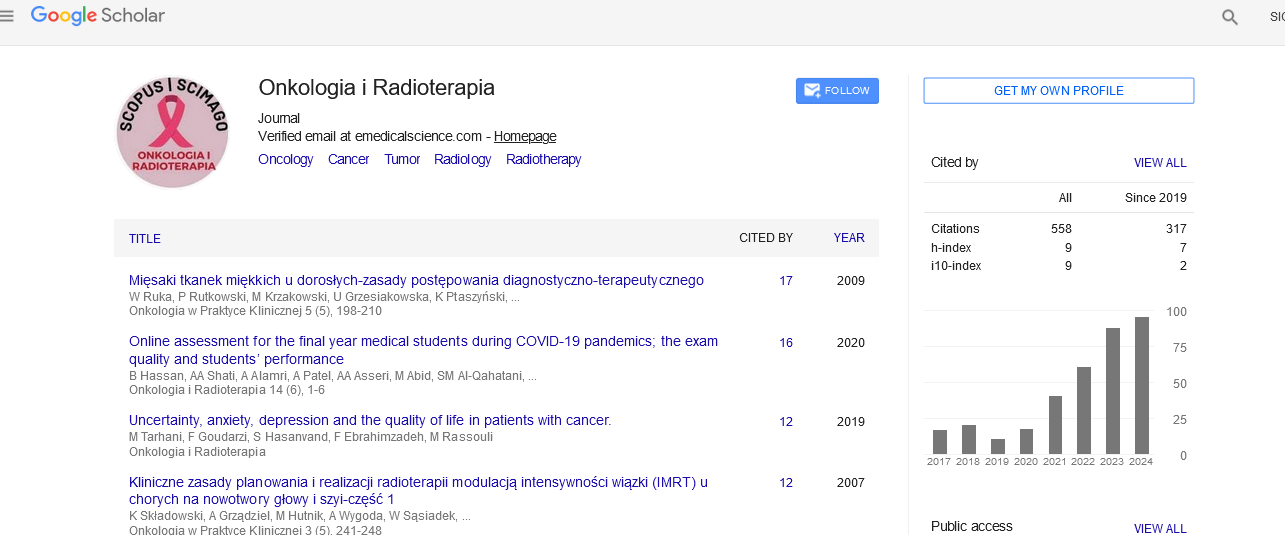
Google Scholar citation report
Citations : 650
Onkologia i Radioterapia received 650 citations as per Google Scholar report
Onkologia i Radioterapia peer review process verified at publons
Indexed In
- Directory of Open Access Journals
- Scimago
- SCOPUS
- EBSCO A-Z
- MIAR
- Euro Pub
- Google Scholar
- Medical Project Poland
- PUBMED
- Cancer Index
- Gdansk University of Technology, Ministry Points 20