Dosimetric Impact of Systematic Hounsfield Units Shifts on Prostate VMAT Treatment Planning
Abstract
Author(s): Imane Hattal*, A. Rrhioua, A. El Outmani, M. Zerfaoui, D. Bakari and Y. Oulhouq
Background: Accurate conversion of computed tomography (CT) Hounsfield Units (HU) into relative electron density (RED) is fundamental for precise dose calculation in external beam radiotherapy. Variations in the HU-RED calibration curve, arising from scanner drift, acquisition parameters, or reconstruction algorithms, may introduce dosimetric uncertainties that could affect treatment outcomes.
Purpose: This study aimed to systematically evaluate the dosimetric impact of HU calibration variations on volumetric modulated arc therapy (VMAT) treatment plans for prostate cancer, focusing on target coverage and organs at risk (OARs) sparing.
Methods: A reference HU-RED calibration curve was established using a CIRS Model 062M electron density phantom scanned with a Philips Brilliance Big Bore CT scanner. Two modified curves were generated by applying systematic shifts of +50 HU and +200 HU. Ten patients with localized prostate cancer, treated with VMAT (78 Gy in 39 fractions), were retrospectively selected. Three treatment plans were generated per patient using each calibration curve. Dosimetric parameters including Dmax, Dmin, Dmean, conformity index (CI), and homogeneity index (HI) for the planning target volume (PTV), along with dose-volume metrics for bladder, rectum, and femoral heads, were compared using the Wilcoxon signed-rank test.
Results: The +50 HU shift produced minimal dosimetric changes (<0.5% for PTV Dmean) without statistical significance (p>0.05). In contrast, the +200 HU shift resulted in statistically significant reductions in PTV Dmax (1.55%, p=0.037) and Dmean (1.26%, p=0.043), along with significant deterioration in CI (6.89% increase, p=0.008). The bladder showed the highest sensitivity with V25Gy variations up to 38.15% (p=0.005), while rectal parameters remained stable across all curves (p>0.05).
Conclusion: HU variations within +50 HU maintain dosimetric accuracy within clinically acceptable thresholds. However, larger calibration errors (+200 HU) can produce significant dosimetric deviations, particularly for soft-tissue OARs. These findings emphasize the importance of rigorous CT calibration protocols and regular quality assurance to ensure treatment planning accuracy in prostate radiotherapy
Share this article

Editors List
-
RAOUi Yasser
Senior Medical Physicist
-
Ahmed Hussien Alshewered
University of Basrah College of Medicine, Iraq
-
Sudhakar Tummala
Department of Electronics and Communication Engineering SRM University – AP, Andhra Pradesh
-
Alphonse Laya
Supervisor of Biochemistry Lab and PhD. students of Faculty of Science, Department of Chemistry and Department of Chemis
- Fava Maria Giovanna
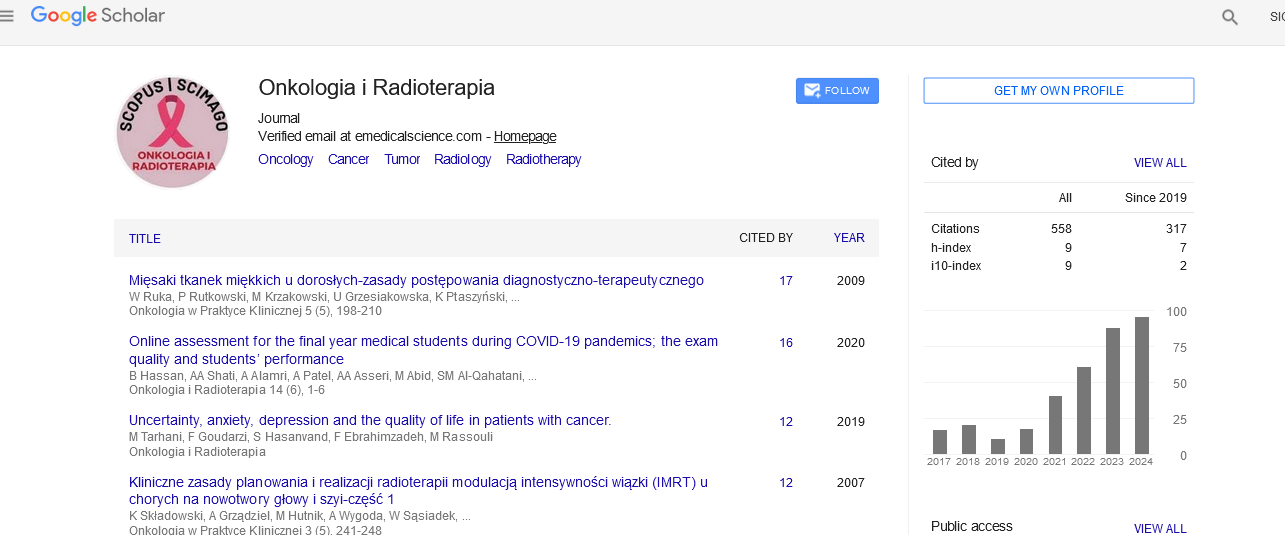
Google Scholar citation report
Citations : 650
Onkologia i Radioterapia received 650 citations as per Google Scholar report
Onkologia i Radioterapia peer review process verified at publons

Indexed In
- Directory of Open Access Journals
- Scimago
- SCOPUS
- EBSCO A-Z
- MIAR
- Euro Pub
- Google Scholar
- Medical Project Poland
- PUBMED
- Cancer Index
- Gdansk University of Technology, Ministry Points 20