Improving Radiotherapy Department Performance Through Lean Management : A Before?After Study
Abstract
Author(s): Samia KHALFI*, Rodouan TOUTI, Abdelkarim UAKKAS, Khadija AMSSAYEF, El Mehdi SADIKI, Youssef AGHLALLOU, Fatima, Zahra FARHANE, Zenab ALAMI, Mouhcine ASSALE and Touria BOUHAFA
Objectives: Lean Management, originally developed in the Japanese automotive industry, is increasingly being applied in healthcare systems. This study aimed to describe the implementation process of Lean Management in a radiotherapy department within an African healthcare setting, to identify and eliminate waste through Value Stream Mapping (VSM), and to quantify the resulting improvements in treatment initiation delays, documentation compliance, and patient satisfaction.
Methods: A one-year before–after observational study was conducted from May 2024 to April 2025 in the radiotherapy department of Hassan II University Hospital in Fez, Morocco, including 945 patients (450 in the pre-Lean period and 495 in the post-Lean period). Value Stream Mapping was used to identify valueadded activities, necessary but non-value-added activities, and pure waste within the care pathway. Four Lean interventions were implemented: digitalization of communication between the four medical teams, improvement of patient reception procedures, optimization of appointment scheduling using a Kanban approach, and the collaborative development of standardized procedures covering the complete care pathway for the main tumor sites. Outcome indicators included the simulation-to-treatment initiation delay, the documentation non-compliance rate, and patient satisfaction scores.
Results: Among the 12 steps identified in the VSM, 7 were classified as value-added activities, 3 as necessary but non-value-added activities, and 2 as pure eliminable waste. The mean simulation-to-treatment initiation delay decreased from 28.4 ± 8.1 days to 16.0 ± 10.2 days, representing a 43.7% reduction (p = 0.043). Root cause analysis identified avoidable re-simulations as the main residual source of waste, associated with an additional delay of 14.2 days per case (30.0 vs 15.8 days). The documentation non-compliance rate decreased from 67.3% to 10.7% (84.1% reduction, p < 0.001), while complete clinical file traceability improved from 32.7% to 100%. Patient satisfaction increased by 25.8% (6.2 to 7.8/10, p < 0.001).
Conclusion: Lean Management, implemented through rigorous Value Stream Mapping and targeted interventions addressing root causes of inefficiencies, significantly improved the organizational performance of a radiotherapy department, even in a resource-constrained African healthcare setting. The identification of avoidable re-simulations as the main residual source of waste and the development of standardized procedures according to tumor site represent key contributions of this initiative. This experience provides a reproducible model for other African hospitals seeking to optimize radiotherapy care pathways.
Share this article

Editors List
-
RAOUi Yasser
Senior Medical Physicist
-
Ahmed Hussien Alshewered
University of Basrah College of Medicine, Iraq
-
Sudhakar Tummala
Department of Electronics and Communication Engineering SRM University – AP, Andhra Pradesh
-
Alphonse Laya
Supervisor of Biochemistry Lab and PhD. students of Faculty of Science, Department of Chemistry and Department of Chemis
- Fava Maria Giovanna
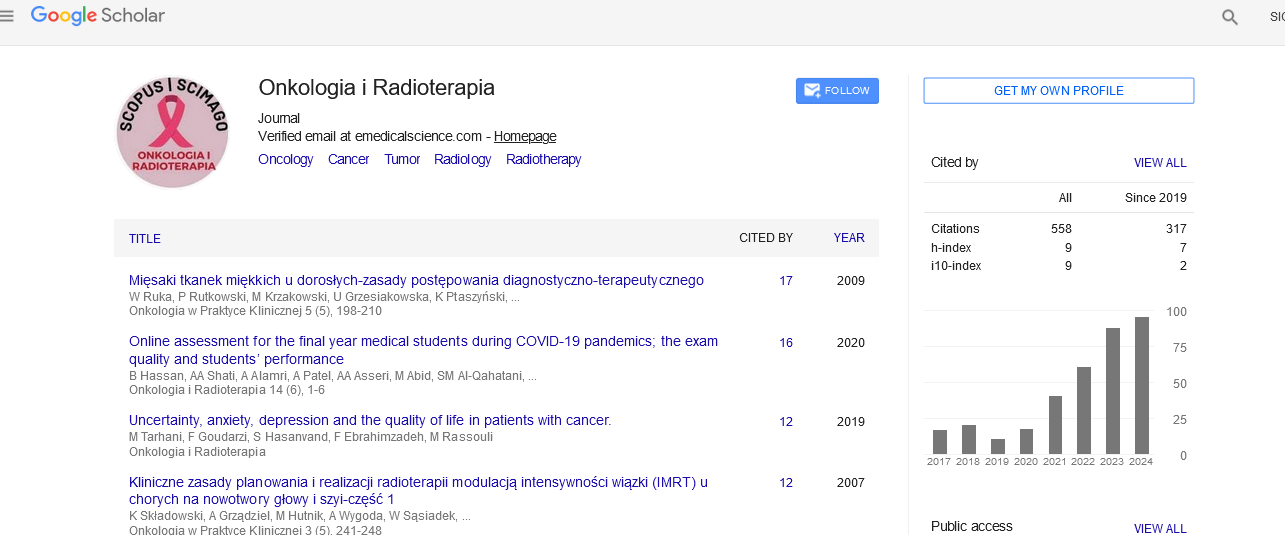
Google Scholar citation report
Citations : 650
Onkologia i Radioterapia received 650 citations as per Google Scholar report
Onkologia i Radioterapia peer review process verified at publons
Indexed In
- Directory of Open Access Journals
- Scimago
- SCOPUS
- EBSCO A-Z
- MIAR
- Euro Pub
- Google Scholar
- Medical Project Poland
- PUBMED
- Cancer Index
- Gdansk University of Technology, Ministry Points 20