Abstract
Author(s): Anil Kumar Y*, Kapu Thirumala, Dileep Kumar Garnipudi, Kommu Pradeep, Y. Sirisha, Naveen Pathakala, Ramshetty Rajendra Prasad and A. Rajesh
Breast cancer remains one of the most commonly diagnosed malignancies and a major cause of cancer-related mortality among women worldwide. Doxorubicin is an anthracycline chemotherapeutic agent widely employed in breast cancer treatment. However, its clinical effectiveness is limited by nonspecific tissue distribution, dose-dependent cardiotoxicity, rapid systemic elimination, and the development of multidrug resistance. Lipid-based nanocarriers may improve the delivery of doxorubicin by modifying its distribution, providing controlled release, and increasing its availability within cancer cells. The present study was designed to formulate, optimize, and evaluate doxorubicin-loaded cubosomes for potential application in breast cancer therapy. Cubosomes were prepared using glyceryl monooleate as the lipid-forming material and poloxamer 407 as the stabilizer through a top-down homogenization and probe-sonication method. The effects of lipid and stabilizer concentrations were evaluated using particle size, polydispersity index, zeta potential, entrapment efficiency, and drug loading as critical formulation parameters. The optimized formulation was further characterized using Fourier-transform infrared spectroscopy, differential scanning calorimetry, X-ray diffraction, and transmission electron microscopy. In vitro drug release was investigated using a dialysis-membrane method, and the resulting data were fitted to mathematical release models. The cytotoxic effects of free doxorubicin, blank cubosomes, and doxorubicin-loaded cubosomes were proposed to be evaluated in MCF-7 breast cancer cells using the MTT assay. The study is expected to determine whether cubosomal encapsulation can provide a physically stable nanosized formulation, sustained doxorubicin release, and improved in vitro anticancer activity. Doxorubicin-loaded cubosomes may represent a promising delivery platform for improving the pharmaceutical performance of doxorubicin; however, their therapeutic and safety advantages require confirmation through reproducible experimental and in vivo investigations.
Share this article

Editors List
-
RAOUi Yasser
Senior Medical Physicist
-
Ahmed Hussien Alshewered
University of Basrah College of Medicine, Iraq
-
Sudhakar Tummala
Department of Electronics and Communication Engineering SRM University – AP, Andhra Pradesh
-
Alphonse Laya
Supervisor of Biochemistry Lab and PhD. students of Faculty of Science, Department of Chemistry and Department of Chemis
- Fava Maria Giovanna
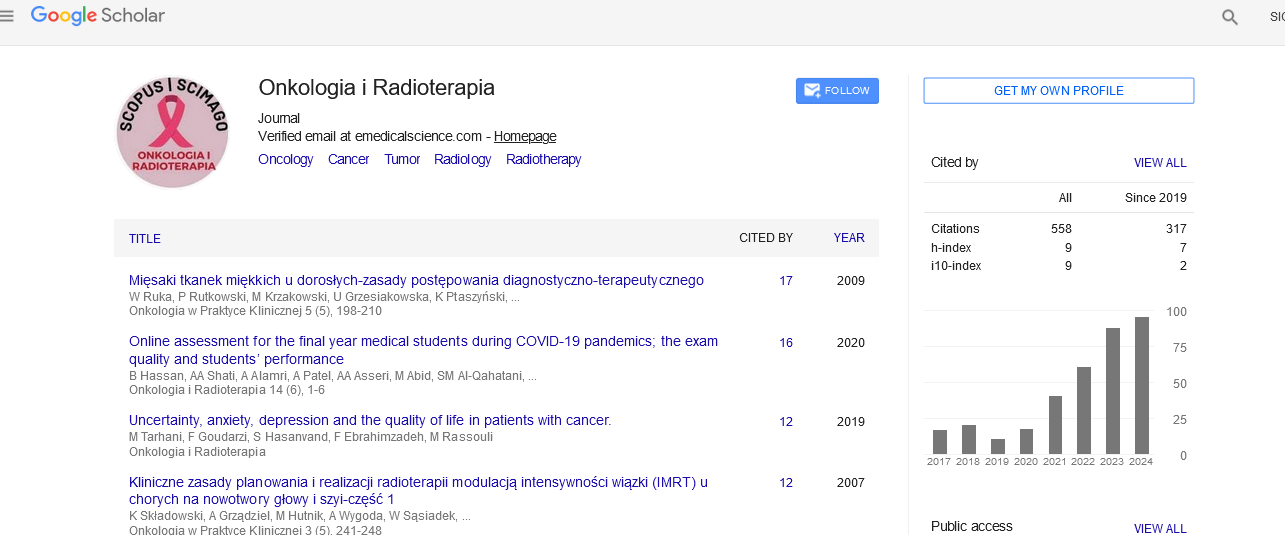
Google Scholar citation report
Citations : 650
Onkologia i Radioterapia received 650 citations as per Google Scholar report
Onkologia i Radioterapia peer review process verified at publons
Indexed In
- Directory of Open Access Journals
- Scimago
- SCOPUS
- EBSCO A-Z
- MIAR
- Euro Pub
- Google Scholar
- Medical Project Poland
- PUBMED
- Cancer Index
- Gdansk University of Technology, Ministry Points 20