Efficacy and Tolerability of CDK4/6 Inhibitors in Patients with HR+/HER2â?? Metastatic Breast Cancer: Real-World Data
Abstract
Author(s): Abir Oufrid*, Basma Aabboub, Diango Keita, Sara Nejjari, Samia El Hakym, Hafssa El Hilali, Chaymae Chbihi, Lamiae Amaadour, Karima Oualla, Zineb Benbrahim, Samia Arifi and Nawfel Mellas
Introduction: Cyclin-dependent kinase 4 and 6 (CDK4/6) inhibitors, in combination with hormone therapy, are currently the standard treatment for hormone receptor–positive, HER2-negative (HR+/HER2−) metastatic breast cancer. Although their efficacy has been demonstrated in randomized clinical trials, real-world data remain limited, particularly in populations underrepresented in pivotal studies. The objective of this study was to evaluate, in a real-world setting, the efficacy and Tolerability of CDK4/6 inhibitors in patients with HR+/HER2− metastatic breast cancer. Methods: This was a retrospective study of patients admitted to the medical oncology department at CHU HASSAN II Hospital in Fès, who received CDK4/6 inhibitors for HR+/HER2− metastatic breast cancer over a six- Year period, from 2018 to 2023, regardless of the date of their first consultation.
Results: Thirty-two patients were included in our study, of whom 54% were postmenopausal at diagnosis. The mean age was 52.42 years (range: 32–93), 19% had a family history of cancer, and 81% had an ECOG Performance status of 1. The most frequent metastatic site was bone, observed in 75% of patients— solitary in 6% and associated with other sites in 69%. Prior treatments had been administered to 56% of patients, including radical mastectomy (68%), adjuvant chemotherapy (28%), radiotherapy (62%), or adjuvant hormone therapy (100%). The hormone therapy administered was based on palbociclib and letrozole. CDK4/6 inhibitors were used as first-line therapy in 79% of patients and after prior Treatment in 21%. The mean follow-up duration was 38.4 months, with a mean progression-free Survival of 20.88 months. Neutropenia was the most frequently observed adverse event, followed by fatigue, anemia, rash, and thrombocytopenia. Neutropenia and thrombocytopenia were the most Severe side effects.
Conclusion: In routine clinical practice, CDK4/6 inhibitors combined with hormone therapy demonstrate significant clinical efficacy and an acceptable tolerability profile in patients with HR+/HER2− metastatic breast cancer. These results confirm the translatability of clinical trial data to real-world settings and support the use of these treatments as a therapeutic cornerstone in this indication.
Share this article

Editors List
-
RAOUi Yasser
Senior Medical Physicist
-
Ahmed Hussien Alshewered
University of Basrah College of Medicine, Iraq
-
Sudhakar Tummala
Department of Electronics and Communication Engineering SRM University – AP, Andhra Pradesh
-
Alphonse Laya
Supervisor of Biochemistry Lab and PhD. students of Faculty of Science, Department of Chemistry and Department of Chemis
- Fava Maria Giovanna
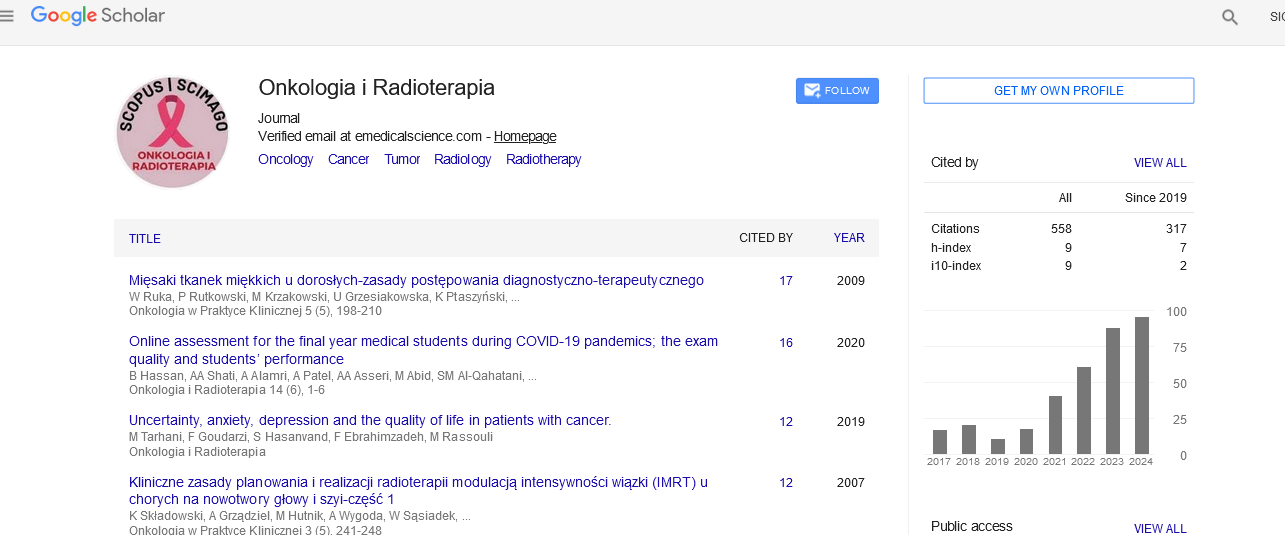
Google Scholar citation report
Citations : 650
Onkologia i Radioterapia received 650 citations as per Google Scholar report
Onkologia i Radioterapia peer review process verified at publons
Indexed In
- Directory of Open Access Journals
- Scimago
- SCOPUS
- EBSCO A-Z
- MIAR
- Euro Pub
- Google Scholar
- Medical Project Poland
- PUBMED
- Cancer Index
- Gdansk University of Technology, Ministry Points 20