Development and Radiological Validation of Heterogeneous Pelvic Phantoms Against a Patient-Derived Distribution: A CT-Based Benchmarking Study of Rectal and Bladder Surrogates
Abstract
Author(s): Wiam EL ATIFI*, Abdelali SLIMANI and Omar EL RHAZOUANI
Background: Heterogeneous physical phantoms reproduce pelvic organ anatomy, yet their radiological representativeness at both whole-organ and wall-contour levels has not been evaluated against clinical CT data. This study benchmarks two heterogeneous phantoms — a polyurethane foam-walled rectal phantom and an epoxy-walled, water-filled bladder phantom — against 50 cervical cancer patients. Materials and Methods: CT-derived mean Hounsfield unit (HU), electron density (ED), and volume were extracted from whole-rectum, rectal-wall, whole-bladder, and bladder-wall contours in 50 female patients (120 kVp, 400 mAs, 0.25 cm slice thickness) using the Elekta Monaco treatment planning system. Both phantoms were geometrically derived from an independent 200-patient average model and scanned under identical CT conditions. A three-tier percentile scoring framework (P25–P75: 2 points; P5–P95: 1 point; outside P5–P95: 0 points) was applied per parameter and contour (maximum 6 points per contour). Results: For the rectal phantom, whole-rectum HU (−635 HU) and ED (0.446) deviated from patient medians by 15,975% and 56.0% respectively, falling below P5 at both contour levels; volumetric agreement was preserved (score: 2/6). For the bladder phantom, whole-bladder and bladder-wall HU and ED also fell below P5 — with smaller absolute deviations — while volume remained within the IQR (score: 2/6 per contour). Neither phantom achieved HU or ED representativeness at any contour level. Conclusion: Geometric fidelity was successfully achieved by both designs, but material composition was the dominant limiting factor for radiological representativeness. Future heterogeneous pelvic phantom development should prioritise tissue-equivalent wall materials and optimised interface geometries to achieve both anatomical and radiological fidelity.
Share this article

Editors List
-
RAOUi Yasser
Senior Medical Physicist
-
Ahmed Hussien Alshewered
University of Basrah College of Medicine, Iraq
-
Sudhakar Tummala
Department of Electronics and Communication Engineering SRM University – AP, Andhra Pradesh
-
Alphonse Laya
Supervisor of Biochemistry Lab and PhD. students of Faculty of Science, Department of Chemistry and Department of Chemis
- Fava Maria Giovanna
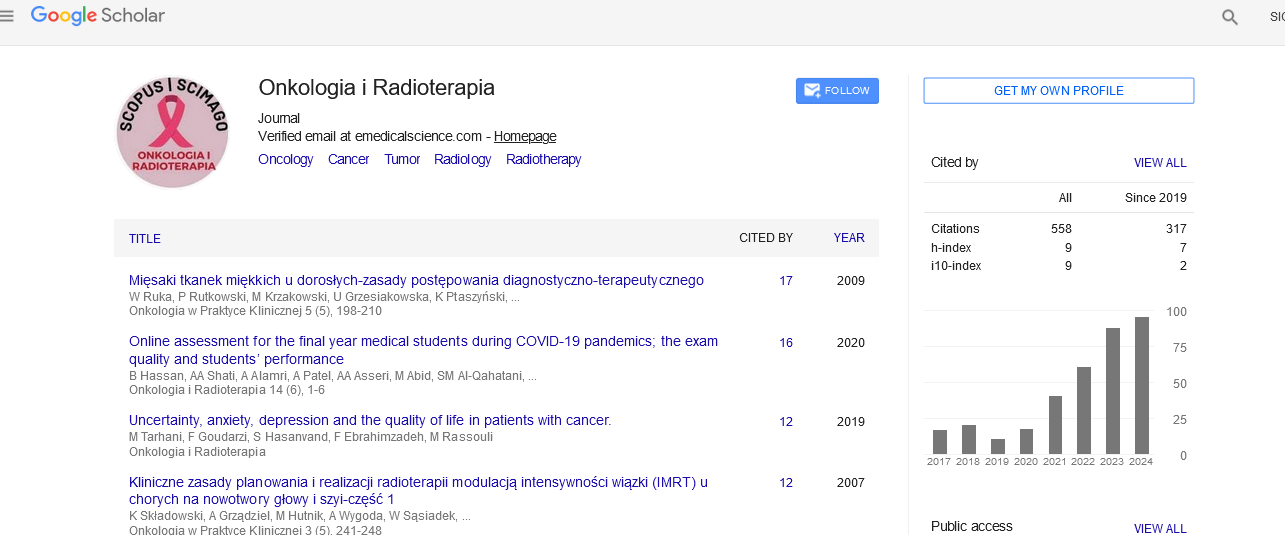
Google Scholar citation report
Citations : 650
Onkologia i Radioterapia received 650 citations as per Google Scholar report
Onkologia i Radioterapia peer review process verified at publons

Indexed In
- Directory of Open Access Journals
- Scimago
- SCOPUS
- EBSCO A-Z
- MIAR
- Euro Pub
- Google Scholar
- Medical Project Poland
- PUBMED
- Cancer Index
- Gdansk University of Technology, Ministry Points 20