Research Article - Onkologia i Radioterapia ( 2026) Volume 20, Issue 7
Endocrine enigma: Game based learning in metabolic and hormonal disorders applicable to oncology practice
Neetha Kundoor*, Srilatha Bashetti and Krishnaveni DesaiNeetha Kundoor, Department of Biochemistry, Apollo Institute of Medical Sciences and Research (AIMSR), Apollo Health City, Jubilee Hills, Hyderabad, India, Email: oncologyradiotherapy99@gmail.com
Received: 15-Jun-2026, Manuscript No. OAR-26-190305; , Pre QC No. OAR-26-190305 (PQ); Editor assigned: 17-Jun-2026, Pre QC No. OAR-26-190305 (PQ); Reviewed: 01-Jul-2026, QC No. OAR-26-190305 ; Revised: 16-Jul-2026, Manuscript No. OAR-26-190305 (R); Published: 23-Jul-2026
Abstract
Background: Effective teaching strategies in oncology and radiotherapy education require approaches that enhance clinical reasoning, interdisciplinary understanding, and long-term knowledge retention. Traditional didactic methods often fail to adequately engage students or support higher-order cognitive development. Game-Based Learning (GBL), particularly puzzle-based approaches, offers a promising strategy to promote active learning and clinical application of biochemical and physiological concepts relevant to cancer and metabolic disorders.
Objective: This study aimed to evaluate the effectiveness of puzzle-based learning in improving undergraduate medical students’ understanding of hormone regulation in metabolic conditions, with potential relevance to oncological and radiotherapeutic contexts, while fostering critical thinking, engagement, and collaborative learning.
Methods: A structured, case scenario–based puzzle learning intervention was implemented, aligned with Bloom’s taxonomy to facilitate higher-order cognitive processes such as analysis and application. Learning preferences were assessed using the VARK model, and student perceptions were collected through structured feedback questionnaires following the intervention.
Results: Kinesthetic learning emerged as the predominant preference, followed by aural and visual modalities. A majority of students reported positive outcomes, with 62% expressing strong satisfaction in puzzle-solving activities and over 50% indicating enhanced engagement and subject interest. Approximately 42-45% of participants demonstrated perceived improvements in critical thinking, problemsolving, and creativity. Notably, 70% agreed that puzzle-based learning promoted meaningful understanding and was more effective than conventional lectures. Students also reported improved knowledge retention, communication skills, and collaborative learning, with all participants expressing willingness to engage in similar methodologies.
Conclusion: Puzzle-based game learning represents an effective, student-centered educational strategy with potential applications in oncology and radiotherapy training. By enhancing analytical thinking, clinical reasoning, and engagement, such innovative approaches can complement traditional teaching methods and contribute to improved competency in complex biomedical and cancer-related education.
Keywords
Game-based learning; Puzzle-based learning; Oncology education; Radiotherapy training; Medical education; VARK learning styles; Critical thinking; Bloom’s taxonomy; Active learning; Clinical reasoning
Introduction
Medical education is undergoing a paradigm shift as educators increasingly face challenges in maintaining students’ attention during lectures, addressing diverse learning preferences, reducing academic stress, and promoting active engagement and peer-topeer learning. Traditional didactic lectures, although essential for delivering foundational knowledge, often fail to fully engage learners or support higher-order cognitive development. Consequently, medical educators are exploring innovative teaching strategies to meet evolving educational needs [1,2].
Game-Based Learning (GBL) has emerged as a promising pedagogical approach in this context, offering interactive and learner-centered environments that enhance student engagement and knowledge retention. Among various forms of GBL, puzzle-based learning has gained attention as an effective and stimulating method. Puzzlesolving promotes critical thinking, encourages active participation, and fosters collaborative learning by improving communication and decision-making skills [3-5].
According to Bloom’s taxonomy, the initial stage of learning focuses on “remembering,” typically achieved through lectures, which forms the basis for understanding fundamental concepts. However, higherorder cognitive skills such as application, analysis, and evaluation require more interactive approaches. Game-based learning, particularly through puzzles, facilitates these advanced cognitive processes by encouraging learners to apply theoretical knowledge to problem-solving situations [6].
Previous studies have demonstrated the effectiveness of puzzlebased learning in medical education. Amit Saxena et al., showed that crossword puzzles serve as an effective active learning tool in undergraduate pathology, improving student engagement and comprehension. Similarly, Mohan BS et al., reported that crossword puzzles enhanced learning outcomes in microbiology and immunology by promoting understanding and retention of key concepts. Supporting this, a systematic review by David R Cook et al., demonstrated that technology-enhanced and interactive learning methods significantly improve knowledge outcomes among health professions students [7,8].
In recent years, GBL and simulation-based learning have gained significant momentum and are increasingly being integrated into traditional medical curricula, particularly in India. Students often tend to focus their learning efforts primarily before examinations; however, GBL encourages continuous engagement by promoting immediate application of knowledge acquired during lectures, thereby reinforcing learning and increasing interest in the subject [9].
To achieve higher levels of Bloom’s taxonomy, particularly the “analysis” stage, case scenario–based puzzles can be effectively utilized. These approaches enable learners to identify gaps in their knowledge, engage in discussion, analyze clinical information, and arrive at logical conclusions through peer interaction. This is especially relevant in subjects like biochemistry, where understanding complex mechanisms is crucial.
In the present study, case scenarios were designed to help learners apply their cognitive skills in understanding hormone mechanisms and their roles in metabolism. Image-based puzzles linked to these scenarios required students to independently acquire foundational knowledge and collaboratively apply it to solve problems and diagnose clinical conditions, thereby reinforcing conceptual understanding and promoting active and self-directed learning.
Motivation plays a critical role in the learning process, and GBL has been shown to enhance intrinsic motivation among learners. Intrinsically motivated students demonstrate deeper engagement, improved critical thinking, and greater cognitive flexibility. Furthermore, the use of immediate rewards has been shown to positively influence learning outcomes and engagement by activating neurocognitive pathways associated with reinforcement [10-14]. Thus, integrating puzzle-based game learning into medical education represents a valuable strategy to promote active learning, enhance cognitive skills, and improve overall educational outcomes.
Aim and objectives: The study aims to evaluate the effectiveness of puzzle-based learning in enhancing students’ understanding of hormone regulation in metabolic disorders by fostering critical thinking skills through active engagement.
Materials and Methods
Study design
A mixed-method experimental study was conducted to evaluate the effectiveness of a game-based learning approach incorporating casebased and puzzle-based strategies aligned with Bloom’s taxonomy. The study integrated both quantitative performance metrics and qualitative learning outcomes.
Study setting and duration
The study was conducted in the Department of Biochemistry, Apollo Institute of Medical Sciences, Hyderabad during the period of December 2024 in a structured classroom setting.
Study population
The study included first year undergraduate medical students.
Sample size
A total of 150 students participated in the study aged between 18- 22 years.
Inclusion criteria
• Phase I undergraduate medical students
• Students present during the scheduled sessions
Exclusion criteria
• Students absent during the sessions
Pre-intervention phase: Prior to the activity, students attended didactic lectures on endocrine physiology focusing on conceptual understanding and clinical relevance. The sessions covered mechanisms of hormone action, including receptor types (membrane-bound and intracellular) and second messenger systems such as cAMP, IP3/DAG, and tyrosine kinase pathways, along with physiological functions of hormones involving carbohydrate, protein, and lipid metabolism, calcium and bone homeostasis, water and electrolyte balance, stress response, and growth and development. Diagnostic and functional aspects including hormone assays and dynamic endocrine function tests were also discussed, ensuring that students developed a strong foundational knowledge base for higher-order cognitive engagement.
Intervention phase: A structured game-based learning activity integrating case-based learning and puzzle-based tasks was conducted in two progressive levels. In Phase 1 (Level 1), students were divided into 15 groups of 10 members each and were assigned five clinical case scenarios based on endocrine disorders, requiring identification of the clinical condition, the hormone involved, its mechanism of action, and correlation with its physiological and biochemical function. Upon correct diagnosis, groups received puzzle blocks representing the hormone, which they were required to assemble within five minutes, followed by identification and explanation of its mechanism and physiological role; one student from each group then presented the case analysis and findings. In Phase 2 (Level 2), the top 10 performing groups advanced to more complex case scenarios requiring integrated understanding of multiple physiological systems and advanced clinical reasoning, including interpretation of metabolic, electrolyte, skeletal, and stress-related effects. More complex puzzles were provided, and performance was evaluated based on accuracy, time taken, and completeness of responses, with the top three groups declared winners.
Educational framework: The intervention was structured in alignment with Bloom’s taxonomy, progressing from knowledge acquisition during lectures (remember), to comprehension through case interpretation (understand), application via puzzle-solving (apply), and higher-order clinical reasoning and presentation (analyze), thereby promoting active learning, teamwork, and application of physiological and biochemical concepts in clinical contexts.
Results
The VARK scoring chart shows that learning preferences vary considerably across questions, but a clear overall pattern emerges. Kinesthetic (K) learning dominates in most questions (e.g., Q1, Q3, Q4, Q6–Q10, Q12–Q16), indicating that the majority of students prefer hands-on, experiential learning approaches. Aural (A) scores are moderately high in several questions (notably Q7, Q8, Q9, and Q14), suggesting that listening-based learning is also important for a subset of students. Read/Write (R) preferences are generally lower but show noticeable peaks in some questions (such as Q9, Q11, and Q16), indicating occasional reliance on text-based learning. Visual (V) scores are the least dominant overall, though certain questions (e.g., Q2, Q11, Q15) show higher visual preference, highlighting variability among learners. Overall, the results suggest that while multimodal tendencies exist, kinesthetic learning is the most prominent style, and effective teaching strategies should incorporate active, practical engagement along with supportive auditory and visual elements to address diverse learner needs (Figure 1).
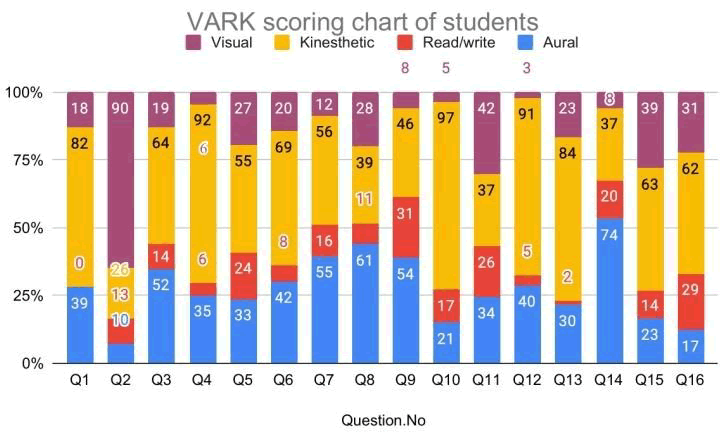
Fig. 1. Distribution of VARK learning preferences (Visual, Aural, Read/Write, Kinesthetic) across 16 questions, showing percentage contributions of each modality with kinesthetic learning predominating in most items.
The VARK scoring chart in this figure shows a pattern consistent with the previous analysis, with kinesthetic learning remaining the dominant modality across most questions, indicating a strong and stable preference for experiential learning among students. Aural scores again demonstrate moderate to high contributions in selected items, while read/write preferences remain comparatively lower with occasional peaks. Visual learning continues to show limited dominance, except in a few questions where it increases. Overall, this figure reinforces the earlier observation of a multimodal distribution with a clear predominance of kinesthetic preference, suggesting reliability and reproducibility of the learning style pattern across assessments (Figure 2).
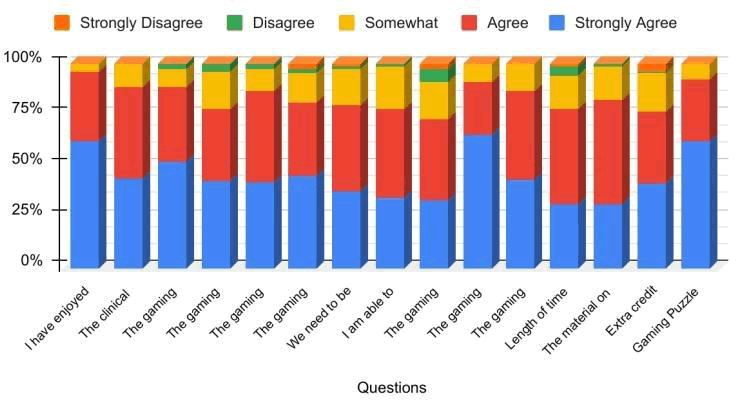
Fig. 2. Students perception on puzzle based learning (Percentage distribution of VARK (Visual, Aural, Read/Write, Kinesthetic) learning preferences across 16 questions, highlighting the predominance of kinesthetic modality.
The results about students perception on puzzle/game based learning showed that about 62% of the students truly enjoyed solving puzzle, 34% agreed the same 44.60% agreed that the session created interest and about 52.20% of the students stated that this activity had stimulated their interest in the subject. 42 to 45% of the students opinioned that the game/puzzle based learning had helped them in polishing their creativity, had helped in enhancing their abilities like problem solving, critical thinking and derived the students focus in gaining knowledge. the students also opinioned that they were able to recall the topics learned while solving the puzzle hence, stated that this method can be used as an assessment tool to evaluate the students. It helped in interaction thus contributes towards improving communication skills. students strongly agreed (70%) that puzzle/game based learning had promoted meaningful learning and are better than the traditional didactic theoretical lectures. they also expressed their satisfaction in the way the activity was conducted in terms of material and time provided for the activity. None of the student disagreed with the advantages of this method of learning is the positive outcome of the study (Figure 3).
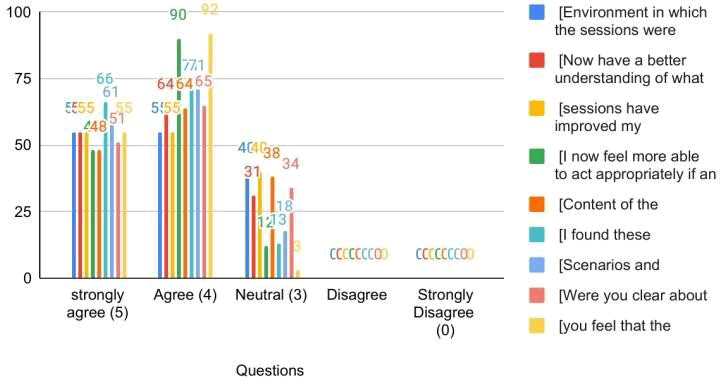
Fig. 3. Distribution of student feedback on puzzle-based learning (Across Likert scale responses, showing overall positive perceptions with most responses clustered in “Agree” and “Strongly agree”.
The student feedback on puzzle-based learning shows a highly positive response, with the majority of students selecting “Agree” and “Strongly agree” across all items, indicating that the sessions were well-received in terms of environment, content, clarity, and usefulness. A substantial proportion reported improved understanding and increased ability to apply knowledge appropriately, while very few students chose neutral responses and almost none selected disagreement options. Overall, the findings suggest that puzzle-based learning is an effective and engaging teaching strategy, enhancing comprehension, application skills, and student satisfaction. Student feedback was positive about the method, its outcome, advantages, learning resources provide and stated that it was confined to first phase of medical academics, stress free and helped to be focused, interactive and confident. The students suggested this method should be adopted to teach complex and tough topics. however, few students expressed that extra time should be provided for learning the concepts prior. 100% of the students expressed there willingness to participant in such methods of learning (Figure 4).
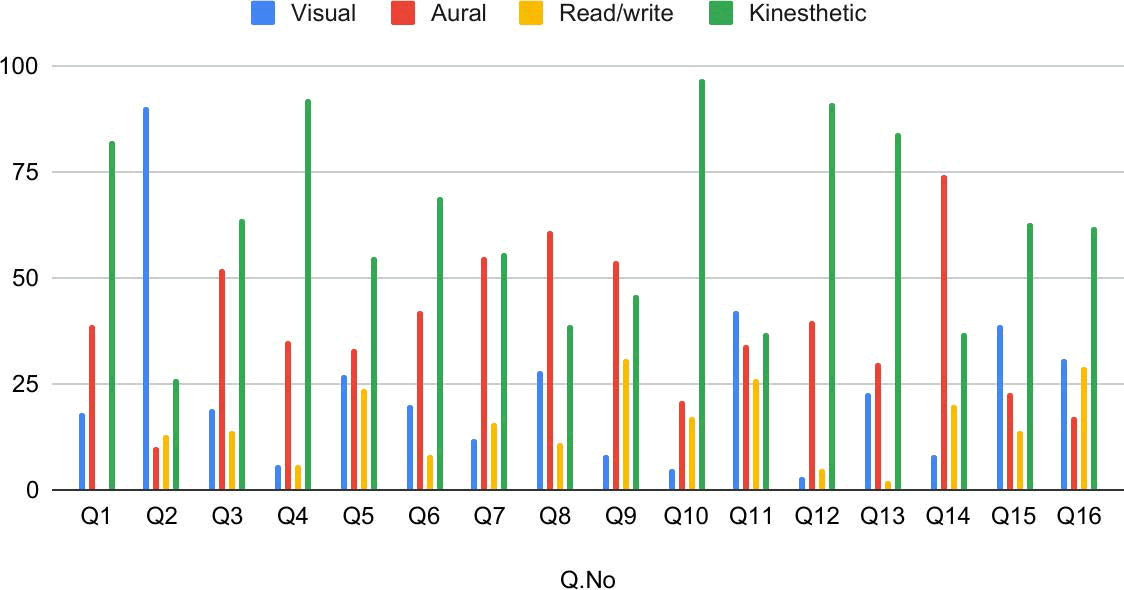
Fig. 4. Comparison of VARK (Visual, Aural, Read/Write, Kinesthetic) learning preferences across 16 questions, illustrating variability in modality distribution with a predominance of kinesthetic responses.
Discussion
Teacher is the best facilitator to understand various learning styles or methods adopted by students in grasping concepts. Creating diversified techniques in medical education is a need of the hour to stimulate students’ interest, improve concentration, and enhance knowledge acquisition. Activity-based or active learning methods promote learning by doing and have been shown to significantly improve student performance and engagement [15,16].
Interest is a key factor influencing students’ learning and plays an essential role in attracting their attention. Attention is closely associated with interest and is often a temporary attribute. It can be categorized into centralized attention, where focus is on a single object, and distributed attention, where focus extends across multiple learning elements and environments. A combination of both is essential for effective learning. Motivation may be intrinsic or extrinsic, both of which influence learning outcomes. It is important to recognize that learning processes vary among students, as each individual adopts unique methods based on their interests and capabilities, making it challenging for educators to tailor teaching strategies [17].
VARK is a widely used tool that helps in identifying different learning preferences among students and understanding dominant learning styles within a group [18,19]. This enables educators to design teaching methods that are beneficial for the majority of learners. Rather than adhering to a single teaching approach, faculty should incorporate innovative strategies to enhance student engagement and participation [20].
In the present study, the majority of students preferred the kinesthetic mode of learning. These learners benefit from physical engagement such as performing tasks and gaining real-life experiences. The second most preferred mode was aural learning, followed by visual learning, while the least preferred mode was read/write. Similar findings have been reported where multimodal and kinesthetic preferences dominate among medical students [21]. Students expressed difficulty in retaining information from traditional didactic lectures, which they perceived as overly theoretical [22].
The findings related to students’ perception of puzzle or game-based learning revealed that a majority of students enjoyed the activity and reported increased interest in the subject. Such approaches enhance creativity, problem-solving ability, and critical thinking skills while improving knowledge retention. Game-based and interactive learning strategies have been shown to improve both cognitive and non-cognitive skills in medical education. Students also reported improved recall and recommended this approach as an effective evaluation tool.
The study demonstrated that puzzle or game-based learning promotes meaningful learning and is more effective than traditional lecture-based teaching. Students showed enthusiasm and willingness to participate in such innovative approaches. These findings are consistent with evidence supporting active learning as a superior pedagogical method. The study design also addressed higher levels of learning, including understanding and application, aligning with Bloom’s revised taxonomy.
Importantly, the integration of endocrine and metabolic concepts through puzzle-based learning has direct implications for oncology education, where understanding hormonal regulation, tumor metabolism, and endocrine-related malignancies is essential for clinical reasoning. Such approaches can help bridge the gap between basic sciences and clinical oncology by enabling students to apply physiological principles in cancer-related contexts, including hormone-dependent tumors and metabolic alterations in malignancy. This reinforces the relevance of interdisciplinary learning in preparing students for complex oncological decisionmaking and radiotherapeutic planning.
However, intrinsic motivation remains a critical factor in achieving effective learning outcomes. Innovative teaching strategies alone may not yield desired results unless students are self-motivated.
Therefore, students must actively engage in their learning process, while educators should continue exploring diverse teaching-learning methods to optimize educational outcomes.
Additionally, integrating active and game-based learning strategies in oncology education has been shown to enhance clinical competence, improve retention of complex cancer-related concepts, and foster interdisciplinary collaboration among learners, thereby supporting the development of future healthcare professionals capable of managing multifaceted oncological conditions.
Conclusion
Fostering intrinsic motivation and implementing diverse, innovative teaching methods are essential for enhancing students' learning experiences and skills acquisition. A combination of studentcentered approaches, such as activity-based and puzzle/game-based learning, can effectively stimulate interest and engagement, while helping students discover the most suitable learning methods for their individual needs. Furthermore, integrating such approaches in endocrine and metabolic education can strengthen clinical reasoning in oncology by enabling better understanding of hormonedependent cancers and metabolic alterations in malignancies.
Limitations of the Study
Planning, implementing within the allocated number of hours with limited resources was very challenging. If all the must know competencies are planned in interactive way students will have a better understanding of the concepts. Pre and post-intervention assessments could have added more value to the study.
Acknowledgement
Would like to thank the whole Department of Biochemistry, Faculty for their support members: Dr. Rekha, Head of the Department, Dr. Radha Kishan. Our senior manager-administration, Mr. Haridhar for providing the resources.
Conflict of Interest
Authors declare no conflicts of interests.
Financial Disclosure
None of the financial agency or grants are available for this research.
Data Access Statement
The corresponding author may provide study data upon reasonable request.
References
- Freeman S, Eddy SL, McDonough M, Smith MK, Okoroafor N, et al. Active learning increases student performance in science, engineering, and mathematics. Proc Natl Acad Sci U S A. 2014; 111:8410-8415.
- Prince M. Does active learning work? A review of the research. J Eng Educ. 2004; 93:223-231.
- Cook DA. The research we still are not doing: An agenda for the study of computer-based learning. Acad Med. 2005; 80:541-548.
[Crossref] [Google Scholar] [PubMed]
- Kolb DA. Experiential learning: Experience as the source of learning and development. Englewood Cliffs, 1984.
- Fleming ND. Teaching and learning styles: VARK strategies. Christchurch, New Zealand: N.D. Fleming; 2001.
- Lujan HL, DiCarlo SE. First-year medical students prefer multiple learning styles. Adv Physiol Educ. 2006; 30:13-16.
[Crossref] [Google Scholar] [PubMed]
- Wehrwein EA, Lujan HL, DiCarlo SE. Gender differences in learning style preferences among undergraduate physiology students. Adv Physiol Educ. 2007; 31:153-157.
[Crossref] [Google Scholar] [PubMed]
- Pashler H, McDaniel M, Rohrer D, Bjork R. Learning styles: Concepts and evidence. Psychol Sci Public Interest. 2008; 9:105-119.
- Graafland M, Schraagen JM, Schijven MP. Systematic review of serious games for medical education and surgical skills training. Br J Surg. 2012; 99:1322-1330.
[Crossref] [Google Scholar] [PubMed]
- Michael J. Where’s the evidence that active learning works? Adv Physiol Educ. 2006; 30:159-167.
- Krathwohl DR. A revision of Bloom’s taxonomy: An overview. Theory Pract. 2002; 41:212-218.
- Cook DA, Levinson AJ, Garside S. Time and learning efficiency in Internet-based learning: A systematic review and meta-analysis. Adv Health Sci Educ Theory Pract. 2010; 15:755-770.
[Crossref] [Google Scholar] [PubMed]
- Harden RM, Laidlaw JM. Essential skills for a medical teacher: An introduction to teaching and learning in medicine. Edinburgh: Elsevier; 2012.
- Biggs J, Tang C. Teaching for quality learning at university. 4th ed. Maidenhead: McGraw-Hill Education; 2011.
- Knowles MS. Self-directed learning: A guide for learners and teachers. New York: Association Press; 1975.
- Ambrose SA, Bridges MW, DiPietro M, Lovett MC, Norman MK. How learning works: Seven research-based principles for smart teaching. San Francisco: Jossey-Bass; 2010.
- Mayer RE. Multimedia learning. Cambridge: Cambridge University Press; 2009.
- Urval RP, Kamath A, Ullal S, Shenoy AK, Shenoy N, et al. Assessment of learning styles of undergraduate medical students using the VARK questionnaire and the influence of sex and academic performance. Adv Physiol Educ. 2014; 38:216-220.
[Crossref] [Google Scholar] [PubMed]
- Gorbanev I, Agudelo-Londoño S, González RA, Cortes A, Pomares A, et al. A systematic review of serious games in medical education: Quality of evidence and pedagogical strategy. Med Educ Online. 2018; 23:1438718.
[Crossref] [Google Scholar] [PubMed]
- McCoy L, Pettit RK, Lewis JH, Bennett T, Carrasco N, et al. Developing technology-enhanced active learning for medical education: Challenges, solutions, and future directions. J Am Osteopath Assoc. 2015; 115:202-211.
[Crossref] [Google Scholar] [PubMed]
- Sandars J, Walsh K. Technology-enhanced learning in medical education: Current trends and future directions. Postgrad Med J. 2016; 92:140-144.
- Murad MH, Varkey P. Self-directed learning in health professions education. Ann Acad Med Singap. 2010; 39:941-944.
[Google Scholar] [PubMed]