Translation for cultural adaptation of a breast cancer questionnaire
Abstract
Author(s): Yuzana Mohd Yusop*, Azlini Chik, Rosliza Yahaya, Muhammad Takiyuddin Abdul Ghani, Wan Mohamad Asyraf Wan Afthanorhan, Zakirah Ahmad Nawi and Harmy Mohamed Yusoff
Background: Malaysia, a country with a population of nearly 35 million, consists of diverse ethnicities and races. This diversity highlights the need for research tools or measures validated across different cultures. The objective of this article was to translate and culturally adapt the Southeast Asian Women's Breast Cancer Questionnaire (SAWBCQ) to fit the Malaysian context.
Materials and methods: The translation and cultural adaptation of the SAWBCQ followed Beaton's recommended steps. This includes translation, synthesis of discrepancies, back translation, and expert committee review and pretesting, and the adaptation procedure involves examining the conceptual and item equivalence. An expert committee synthesized and compared two forward and two back translations. Subsequently, the instrument underwent pretesting, and necessary adjustments were made. In the pretest, a total of 25 participants answered the questionnaires and evaluated them based on understandability, clarity, relevance, and simplicity. Vocabulary variations were resolved through consensus among translators during the translation process.
Results: The expert committee concluded that the Malay version achieved semantic, idiomatic, cultural, and conceptual equivalence, although some adjustments were necessary. Pretesting and face validity were conducted on the adult participants, with 80.0% finding the items comprehensible. The SAWBCQ was successfully translated and culturally adapted to the Malay version, which is easily understandable, clear, simple and relevant to Malaysian culture.
Conclusion: It is crucial to assess the questionnaire's properties to ensure that an adapted version can be made available. The incompatibility of the original questionnaire emphasizes the importance of adapting instruments to current research settings. It also emphasizes the significance of ensuring that concepts within an instrument are equal between the original and target language and context. Thus, it is essential to consider possible barriers when directly comparing different nations, cultures, and times.
Share this article

Editors List
-
RAOUi Yasser
Senior Medical Physicist
-
Ahmed Hussien Alshewered
University of Basrah College of Medicine, Iraq
-
Sudhakar Tummala
Department of Electronics and Communication Engineering SRM University – AP, Andhra Pradesh
-
Alphonse Laya
Supervisor of Biochemistry Lab and PhD. students of Faculty of Science, Department of Chemistry and Department of Chemis
- Fava Maria Giovanna
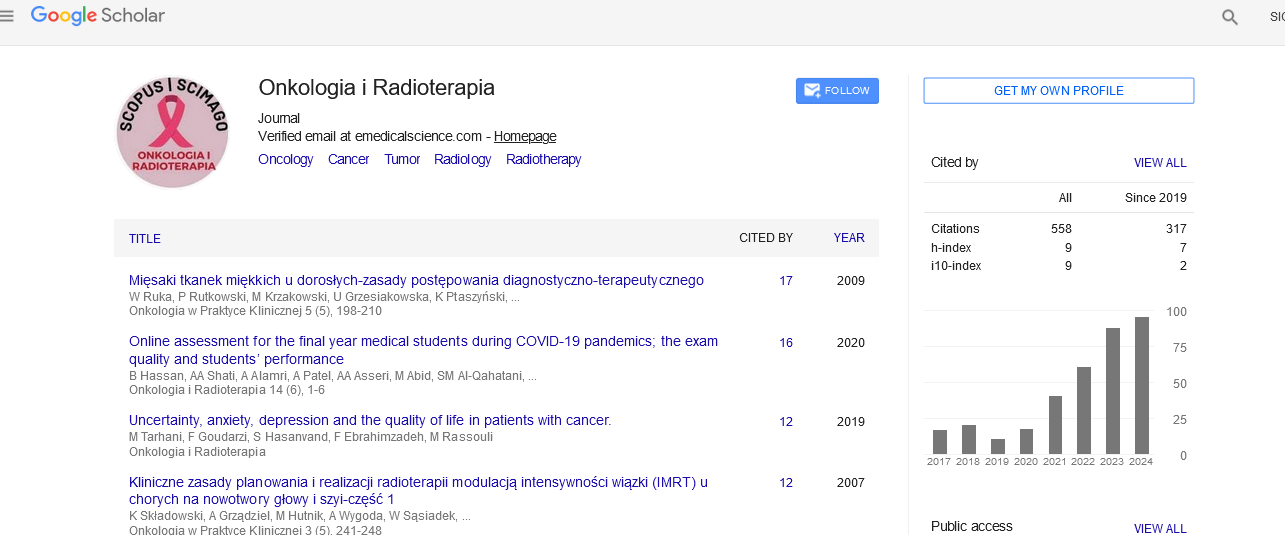
Google Scholar citation report
Citations : 650
Onkologia i Radioterapia received 650 citations as per Google Scholar report
Onkologia i Radioterapia peer review process verified at publons
Indexed In
- Directory of Open Access Journals
- Scimago
- SCOPUS
- EBSCO A-Z
- MIAR
- Euro Pub
- Google Scholar
- Medical Project Poland
- PUBMED
- Cancer Index
- Gdansk University of Technology, Ministry Points 20