Evaluation of urogynecological and sexual functions in patients with vulvar cancer
Abstract
Author(s): Belma Gozde Ozdemir*, Merve Nur Taspınar, Ipek Munteha Erdemli, Ahmet Bilgi and Cetin Celik
Background/Aim: Vulvar cancer is an uncommon gynecologic malignancy that may present with symptoms such as pruritus, pigmentation changes, bleeding, palpable masses, or condylomatous lesions, although some patients remain asymptomatic. Surgical management is planned according to tumor stage, lymph node involvement, localization, patient age, and accompanying comorbidities. Because the vulva is anatomically close to the urinary and reproductive systems, both surgical treatment and chemoradiotherapy can negatively influence urinary and sexual functions. This study aimed to evaluate the impact of surgical treatment for vulvar malignancies on patients’ urogynecological health and sexual functioning.
Material/Methods: Patients diagnosed with vulvar cancer and women of similar age without vulvar cancer were included as two separate groups. Participants completed a questionnaire-based assessment. In this retrospective study, sexual and urinary outcomes were evaluated using the Female Sexual Function Index (FSFI), the Urinary Incontinence Quality of Life Scale (I-QOL), and the Bristol Female Lower Urinary Tract Symptoms Index (BFLUTS).
Results: A total of 31 women were included in the study, consisting of 11 patients with vulvar cancer and 20 control participants without vulvar cancer. Sexual function scores differed significantly between the two groups at the 1st, 3rd, and 6th postoperative months (p<0.05). Patients without vulvar cancer demonstrated consistently higher sexual function scores compared with patients who underwent vulvar cancer treatment. In contrast, urinary symptom scores and urological quality-of-life measures were comparable between the groups, with no statistically significant differences observed.
Conclusions: Treatment for vulvar cancer appears to have a substantial effect on sexual function, whereas urinary outcomes remain largely unchanged. Personalized counseling and close postoperative support are important to improve adaptation, treatment compliance, and overall quality of life.
Brief summary: Surgical treatment for vulvar cancer significantly impacts sexual functioning but shows limited effect on urinary symptoms and urinary quality of life. Individualized postoperative counseling may help improve patient well-being and recovery.
Share this article

Editors List
-
RAOUi Yasser
Senior Medical Physicist
-
Ahmed Hussien Alshewered
University of Basrah College of Medicine, Iraq
-
Sudhakar Tummala
Department of Electronics and Communication Engineering SRM University – AP, Andhra Pradesh
-
Alphonse Laya
Supervisor of Biochemistry Lab and PhD. students of Faculty of Science, Department of Chemistry and Department of Chemis
- Fava Maria Giovanna
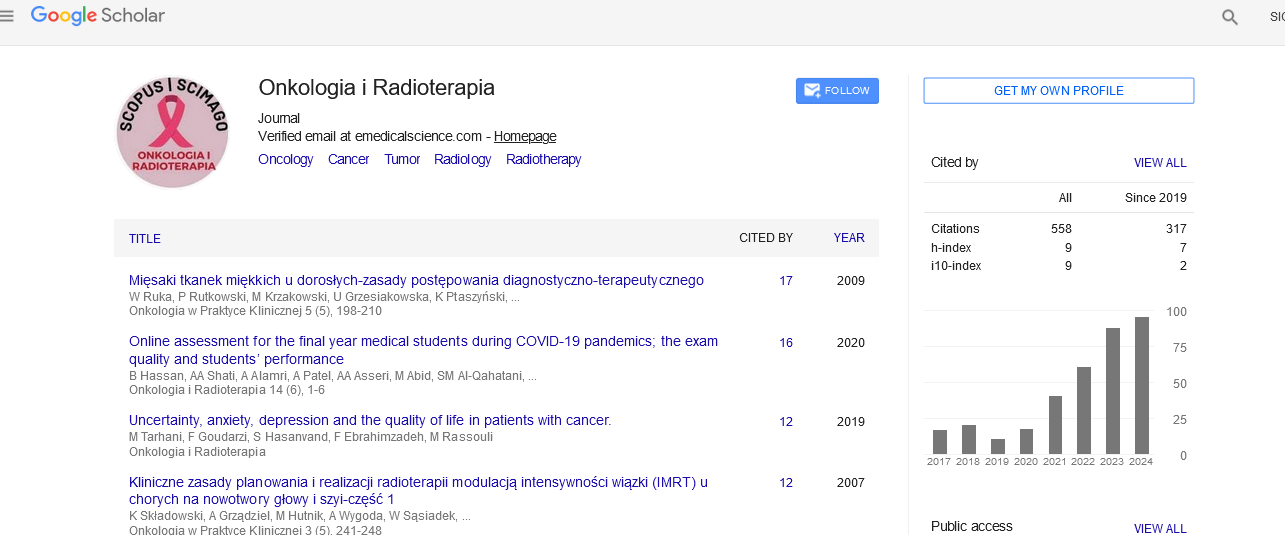
Google Scholar citation report
Citations : 650
Onkologia i Radioterapia received 650 citations as per Google Scholar report
Onkologia i Radioterapia peer review process verified at publons
Indexed In
- Directory of Open Access Journals
- Scimago
- SCOPUS
- EBSCO A-Z
- MIAR
- Euro Pub
- Google Scholar
- Medical Project Poland
- PUBMED
- Cancer Index
- Gdansk University of Technology, Ministry Points 20