Establishing Locally Derived Gamma Passing-Rate Tolerance Limits for Patient-Specific VMAT Quality Assurance: A Retrospective ROC-Based Analysis in a Moroccan Radiotherapy Center
Abstract
Author(s): Adil El Badaoui1*, Mourad Trihi1
Background and purpose: Gamma-index acceptance criteria for patient-specific volumetric-modulated arc therapy (VMAT) quality assurance (QA) are largely inherited from Western cohorts, and North African centers routinely apply the AAPM Task Group 218 (TG-218) universal threshold without local validation. We derived and clinically validated institution-specific gamma passing-rate (GPR) tolerance limits for a Moroccan tertiary radiotherapy department. Materials and methods: One hundred fifty consecutive patient-specific VMAT plans (five anatomical sites; January 2022–December 2023) underwent pretreatment QA on an EPID-based system (iViewDose™, Elekta) and a cylindrical diode array (ArcCHECK™, Sun Nuclear) at 3%/3 mm, 3%/2 mm, and 2%/2 mm (global normalization, 10% dose threshold). GPR was correlated with threedimensional dose-volume histogram (DVH) deviations reconstructed from measurement (3DVH), specifically ΔD95 of the planning target volume (PTV) and ΔDmax of organs at risk (OAR). Receiver-operating-characteristic (ROC) curves, optimized by the Youden index and constrained to sensitivity ≥ 90% and specificity ≥ 85%, defined action and tolerance limits; Pearson correlations were reported with 95% confidence intervals (CI) obtained by Fisher z-transformation. Results: Mean ± SD GPR was 96.8 ± 2.4% (3%/3 mm), 94.2 ± 3.1% (3%/2 mm), and 89.3 ± 4.8% (2%/2 mm); all distributions were left-skewed (skewness, −1.3 to −2.1). ROC-optimized local limits were 95%/90% (action/tolerance) for 3%/3 mm, 92%/87% for 3%/2 mm, and 88%/82% for 2%/2 mm. GPR correlated inversely with ΔD95 PTV (r = −0.68; 95% CI, −0.76 to −0.58; P < .001; AUC = 0.84). A composite criterion (mean of 3%/2 mm and 2%/2 mm) achieved the best discrimination (AUC = 0.88; Youden J = 0.80) at 90%/85%. EPID readings were 1.2 percentage points (95% CI, 1.07–1.33) lower than ArcCHECK, without loss of diagnostic equivalence (AUC 0.83 vs 0.82; P = .71). Conclusion: Institution-specific thresholds were systematically stricter than the TG-218 universal recommendation and improved detection sensitivity for clinically significant errors from 82% to 94% at an acceptable 11% false-positive rate. This retrospective ROC-optimization framework is directly transferable to other resource-constrained radiotherapy centers seeking evidence-based, contextspecific QA tolerances.
Share this article

Editors List
-
RAOUi Yasser
Senior Medical Physicist
-
Ahmed Hussien Alshewered
University of Basrah College of Medicine, Iraq
-
Sudhakar Tummala
Department of Electronics and Communication Engineering SRM University – AP, Andhra Pradesh
-
Alphonse Laya
Supervisor of Biochemistry Lab and PhD. students of Faculty of Science, Department of Chemistry and Department of Chemis
- Fava Maria Giovanna
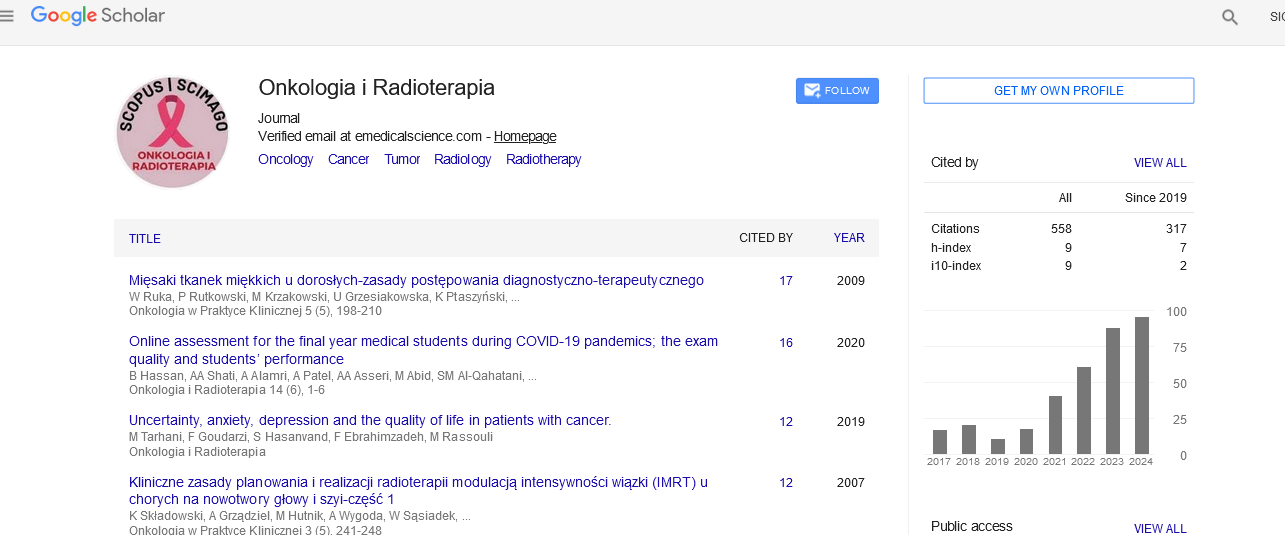
Google Scholar citation report
Citations : 650
Onkologia i Radioterapia received 650 citations as per Google Scholar report
Onkologia i Radioterapia peer review process verified at publons

Indexed In
- Directory of Open Access Journals
- Scimago
- SCOPUS
- EBSCO A-Z
- MIAR
- Euro Pub
- Google Scholar
- Medical Project Poland
- PUBMED
- Cancer Index
- Gdansk University of Technology, Ministry Points 20