Benchmarking ionization chambers, microDiamond detector, and radiochromic film for small-field photon dosimetry on an Elekta Versa HD
Abstract
Author(s): F. Er Radi, O. El mouden*, A. Bannan, Y. Himmi, H. Rafik and O.El Bounagui
Accurate small-field dosimetry remains detector-dependent, particularly for SRSrelevant apertures and highly modulated MLC patterns. This work benchmarks commonly available detectors on an Elekta Versa HD by comparing three ionization chambers (Farmer 0.6 cc, Semiflex 0.125 cc, PinPoint 3D 0.016 cc), a solid-state detector (PTW microDiamond 60019), and Gafchromic EBT3 film. Measurements were performed in water for 6 MV and 10 MV photon beams in flattened (FF) and flattening-filter-free (FFF) modes. Percent depth doses and lateral profiles were acquired for square fields across the small-field range, and relative output factors (OFs) were reported using a 5×5 cm² intermediate-field daisy-chain normalization. Static QA patterns (picket-fence 2-mm slits, step-andshoot staircase, and an SRS 5×5-mm² small-segment grid) were evaluated at 10 cm depth using local 1D gamma analysis in a high-dose/high-gradient ROI, with comparisons performed against both the TPS and film. Detector dependence in OFs was maximal at 1×1 cm² and decreased rapidly with field size. Relative to film, microDiamond showed a consistent ≈+1.6% over-response at 1×1 cm² (e.g., 6 MV FF: 0.735 vs 0.723; 10 MV FF: 0.714 vs 0.702), while PinPoint 3D under-responded by −1.8% at 6 MV (e.g., 6 MV FFF: 0.714 vs 0.726) and by −3.8% at 10 MV (e.g., 10 MV FF: 0.676 vs 0.702; 10 MV FFF: 0.679 vs 0.705). At 2×2 cm², agreement improved (microDiamond +0.2–0.3%, PinPoint −0.3 to −0.4%, Semiflex ≈−0.7 to −0.8%), and by 3×3 cm² all systems converged toward film (typically ≤0.1%). For static QA patterns, mean (range) gamma pass rates versus TPS at 2%/2 mm were 97.0% (90.9–100) for microDiamond and 93.4% (77.3–100) for PinPoint, compared with 62.8% (22.7–80.2) for Semiflex and 44.7% (9.1–67.9) for Farmer; relaxing to 3%/3 mm increased pass rates to 98.9% and 98.4% (microDiamond/PinPoint), versus 80.7% and 58.3% (Semiflex/Farmer). Using film as reference reduced pass rates in the most modulated regions at 2%/2 mm (means: microDiamond 76.0%, PinPoint 76.9%, Semiflex 58.3%, Farmer 43.4%), and the TPS–film comparison itself reached 77.7% at 2%/2 mm. Overall, high-resolution systems (microDiamond and film) provided the most reliable performance for the smallest fields and highly modulated patterns, whereas ionization chambers especially larger volumes showed increasing volume-averaging effects that degrade OF accuracy and modulation fidelity; a 5×5 cm² daisy-chain normalization improved practical traceability when combining detectors across field sizes.
Share this article

Editors List
-
RAOUi Yasser
Senior Medical Physicist
-
Ahmed Hussien Alshewered
University of Basrah College of Medicine, Iraq
-
Sudhakar Tummala
Department of Electronics and Communication Engineering SRM University – AP, Andhra Pradesh
-
Alphonse Laya
Supervisor of Biochemistry Lab and PhD. students of Faculty of Science, Department of Chemistry and Department of Chemis
- Fava Maria Giovanna
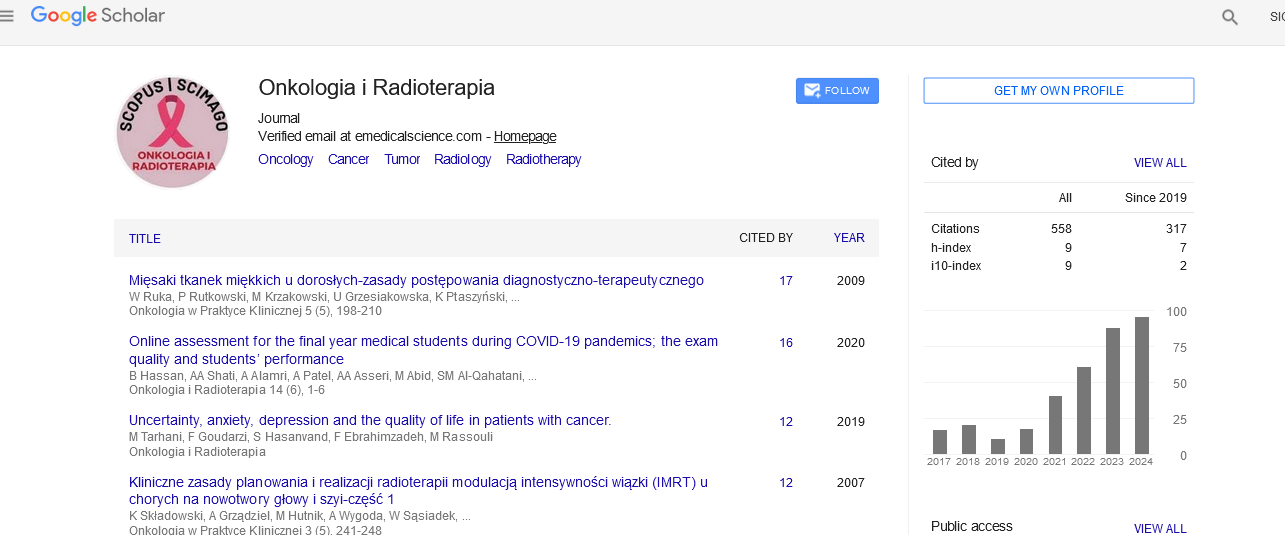
Google Scholar citation report
Citations : 650
Onkologia i Radioterapia received 650 citations as per Google Scholar report
Onkologia i Radioterapia peer review process verified at publons

Indexed In
- Directory of Open Access Journals
- Scimago
- SCOPUS
- EBSCO A-Z
- MIAR
- Euro Pub
- Google Scholar
- Medical Project Poland
- PUBMED
- Cancer Index
- Gdansk University of Technology, Ministry Points 20