Beam Energy Effects in Small-Field Dosimetry for 6 MV FFF and 10 MV FFF on Elekta Versa HD
Abstract
Author(s): Ouafae CHFIK*, EL Mahjoub CHAKIR, Mohamed OUALI ALAMI, Khalid EL OUARDY, Mohamed elghalmi and Yassine HERRASSI
Flattening-filter-free (FFF) photon beams are increasingly used in modern radiotherapy due to their higher dose rates and reduced head scatter. In this study, we investigate the dosimetric differences between 6 MV FFF and 10 MV FFF photon beams from an Elekta Versa HD linear accelerator, with a focus on small field sizes (≤5×5 cm²). Percentage depth-dose (PDD) curves, lateral dose profiles, and relative output factors were measured in a water phantom using an ultra- small ionization chamber (IBA CC01, active volume 0.01 cm³) for field sizes of 1×1, 2×2, 3×3, 4×4, 5×5 cm², with 10×10 cm² as reference. The measured data were compared against the Elekta Golden Beam Data (GBD) provided by the linac manufacturer to verify beam model accuracy. Our results show that 10 MV FFF beams have a deeper depth of maximum dose and higher percentage depth-dose at deeper depths compared to 6 MV FFF beams, consistent with the higher beam energy. However, 6 MV FFF beams exhibit slightly higher relative dose in the buildup region (near-surface) than 10 MV FFF. Lateral profile measurements reveal that both energies produce similar small-field profiles with steep penumbras and symmetric dose distribution, although 10 MV FFF profiles have marginally broader penumbra. Measured output factors Jan ease with field size for both energies; the 1×1 cm² field output factor was~0.69 for 6 MV FFF and ~0.66 for 10 MV FFF, indicating a small reduction at higher energy. Overall, excellent agreement (within~2%/1 mm) was observed between our measurements and the manufacturer’s golden beam reference data [1]. This work confirms that both 6 MV FFF and 10 MV FFF beams on the Elekta Versa HD can be dosimetrically modeled and measured with high accuracy even for very small fields, and it highlights the distinct depth-dose characteristics of the two energies. These findings support confidence in treatment planning system commissioning for small-field stereotactic applications and provide guidance on energy selection for superficial versus deep-seated lesions.
Share this article

Editors List
-
RAOUi Yasser
Senior Medical Physicist
-
Ahmed Hussien Alshewered
University of Basrah College of Medicine, Iraq
-
Sudhakar Tummala
Department of Electronics and Communication Engineering SRM University – AP, Andhra Pradesh
-
Alphonse Laya
Supervisor of Biochemistry Lab and PhD. students of Faculty of Science, Department of Chemistry and Department of Chemis
- Fava Maria Giovanna
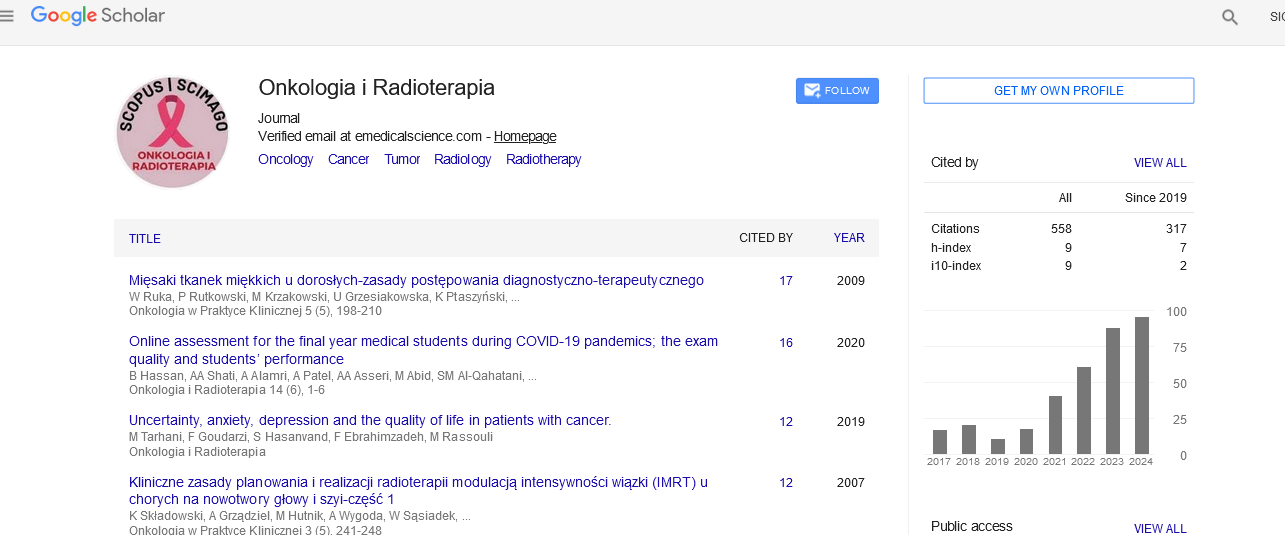
Google Scholar citation report
Citations : 650
Onkologia i Radioterapia received 650 citations as per Google Scholar report
Onkologia i Radioterapia peer review process verified at publons

Indexed In
- Directory of Open Access Journals
- Scimago
- SCOPUS
- EBSCO A-Z
- MIAR
- Euro Pub
- Google Scholar
- Medical Project Poland
- PUBMED
- Cancer Index
- Gdansk University of Technology, Ministry Points 20