Personalized Radiotherapy Strategies and Prognostic Factors in Patients with Soft Tissue Sarcomas: A Retrospective Cohort Study
Abstract
Author(s): Otabek Agzamovテつケ,テつイ, Bekzod Usmanovテつケ,テつイ, Guli Mansurovaテつケ,テつイ, Kamola Saidovaテつイ, Nargiza Karimovaテつケ,テつイ, Ekaterina Chenテつイ, Mukhayo Khayitboeva3*
Background: Soft tissue sarcomas (STS) are rare and biologically heterogeneous malignant mesenchymal tumors characterized by diverse histological subtypes, a high propensity for local recurrence, and the potential for distant metastasis. The present study aimed to evaluate the clinical and morphological characteristics of STS and to identify factors associated with tumor recurrence, metastatic progression, and treatment outcomes. Methods: A retrospective cohort study included 101 consecutive patients with histologically confirmed STS treated at the Republican Specialized Scientific- Practical Medical Center of Oncology and Radiology (Tashkent, Uzbekistan) between 2018 and 2023. Clinical and pathological variables included age, sex, tumor location, grade of differentiation, metastatic status, treatment characteristics, radiotherapy technique, and treatment-related toxicity. According to the predominant radiotherapy technique, patients were classified into three groups: three-dimensional conformal radiotherapy (3D-CRT; n = 41), intensity- modulated radiotherapy (IMRT; n = 32), and volumetric modulated arc therapy (VMAT; n = 28). Descriptive statistics, Pearson's chi-square test, and multivariable logistic regression analysis were performed. Results: Lower-extremity tumors represented the most common anatomical location (49.5%), and high-grade disease predominated (G3, 44.6%). Metastatic progression occurred in 20 patients (19.8%), whereas 63 patients (62.4%) remained alive without evidence of disease progression at the time of analysis. Tumor location significantly influenced radiotherapy selection (χ² = 22.48; p < 0.05). Early radiation-related skin toxicity occurred more frequently after 3D-CRT, whereas IMRT and VMAT demonstrated lower rates of treatment-related adverse events. Multivariable logistic regression analysis identified increasing age (OR = 1.03, 95% CI: 1.00–1.07, p = 0.032) and the presence of metastatic disease (OR = 20.19, 95% CI: 2.46–165.70, p = 0.005) as independent factors associated with tumor recurrence. Conclusions: Personalized radiotherapy strategies based on tumor location, biological characteristics, and treatment context were associated with favorable oncological outcomes in patients with STS. Highly conformal techniques, including IMRT and VMAT, demonstrated lower treatment-related toxicity and may represent valuable approaches for anatomically complex and biologically aggressive tumors. Increasing age and metastatic disease were independently associated with tumor recurrence.
Share this article
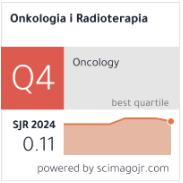

Editors List
-
RAOUi Yasser
Senior Medical Physicist
-
Ahmed Hussien Alshewered
University of Basrah College of Medicine, Iraq
-
Sudhakar Tummala
Department of Electronics and Communication Engineering SRM University – AP, Andhra Pradesh
-
Alphonse Laya
Supervisor of Biochemistry Lab and PhD. students of Faculty of Science, Department of Chemistry and Department of Chemis
- Fava Maria Giovanna
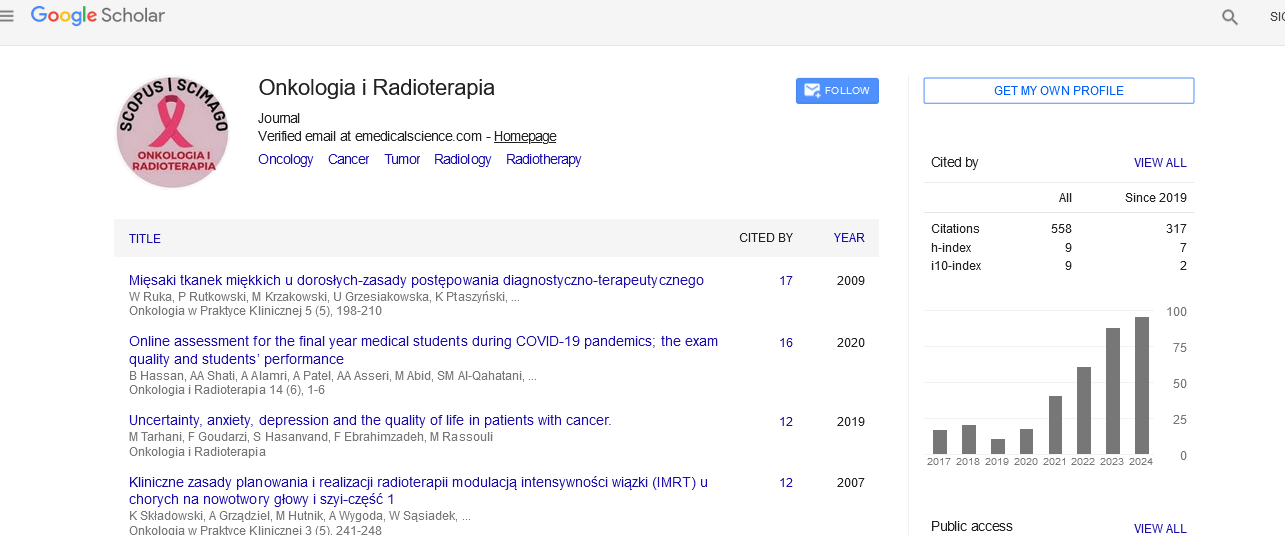
Google Scholar citation report
Citations : 650
Onkologia i Radioterapia received 650 citations as per Google Scholar report
Onkologia i Radioterapia peer review process verified at publons
Indexed In
- Directory of Open Access Journals
- Scimago
- SCOPUS
- EBSCO A-Z
- MIAR
- Euro Pub
- Google Scholar
- Medical Project Poland
- PUBMED
- Cancer Index
- Gdansk University of Technology, Ministry Points 20